
A/Professor Qianbing Zhang

A/Professor Qianbing Zhang
Qianbing Zhang is an Associate Professor specialising in Geomechanics, Tunnelling and Underground Infrastructure. He earned his PhD from EPFL and, prior to joining Monash in 2015, was a postdoctoral researcher at the University of Cambridge. He is an ARC Future Fellow and former ARC DECRA Fellow (2020-2022), recipient of John Booker Medal from Australian Academy of Science (AAS), Fellow of Engineers Australia (FIEAust), and Chartered Professional Engineer (CPEng). He serves as Editor-in-Chief of Tunnelling and Underground Space Technology (TUST, JCR-Q1 journal) and Vice-President (2023–2027) of International Society for Rock Mechanics and Rock Engineering (ISRM).
Qianbing leads Monash GeoExtremes (MGE) Lab and is the founder of X-Twin, a Digital Twin platform for infrastructure lifecycle management. His research integrates geomechanics, rock mechanics, advanced experimentation, multi-physics modelling, AI and Digital Twins to improve the safety, resilience and sustainability of infrastructure.
Qualifications
- CPEng in Civil and Geotechnical Engineering, Engineers Australia (EA), Australia
- Ph.D. in Geomechanics, Swiss Federal Institutes of Technology in Lausanne (EPFL), Switzerland
- M.Sc. in Geotechnical Engineering, Shandong University & The Hong Kong Polytechnic University, China
- B.Eng. (Hons.) in Civil Engineering, Southwest Jiaotong University, China
Expertise
- Underground Construction Technologies
Geographic information system (GIS), Geological Modelling, and Geotechnical Modelling & Monitoring for Building Information Modelling (BIM): GeoM4BIM is a modelling system developed preferentially for underground constructions and mining (Huang et al. 2021).

Multi-LOD BIM for underground metro station: We proposed a workflow to offer an automated error-free, design-to-design solution, and hence enables the efficient exploration of design scenarios and construction optimisation before IFC is adopted by geotechnical modelling software (Huang et al. 2022).

Integrated framework for embodied carbon assessment and construction feasibility: The design and construction of sustainable underground infrastructure will be highly benefited from adopting digitalisation and innovative construction technologies. We developed a framework by integrating digitalisation, interoperability and embodied carbon for a prefabricated underground station. A multi-LoD prefabricated station is developed to verify the proposed framework (Huang et al. 2023).

- Dynamic Fracturing of Materials: Experiment
The split Hopkinson pressure bar (SHPB) or Kolsky bar has been widely used for the determination of dynamic properties of materials at high strain rates (Zhang and Zhao 2014).
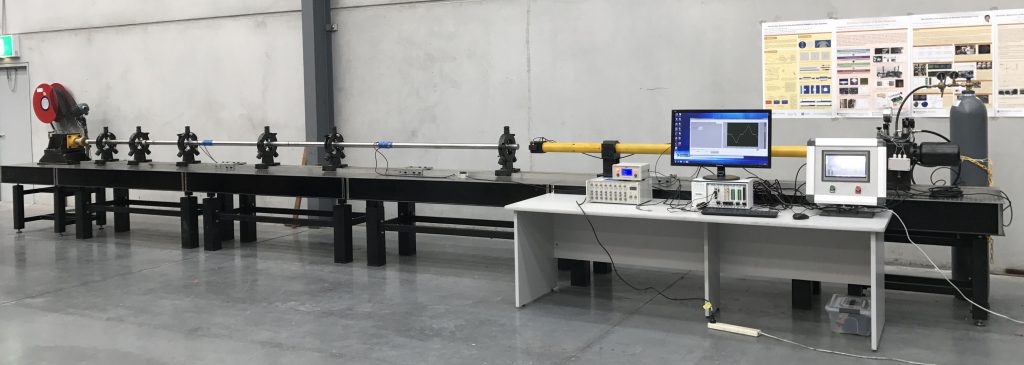
A triaxial Hopkinson pressure bar (ARC LE150100058) is developed to apply initial pre-stresses achieving various in-situ stress conditions, including uniaxial (σ1>σ2=σ3=0), biaxial (σ1≥σ2>σ3=0) and triaxial (σ1≥σ2≥σ3 ≠0) confinements, and then to determine dynamic properties of materials under multiaxial pre-stress states (Liu et al. 2019) and (Zhang et al. 2022).

Dynamic Behaviours of Geomaterials in Underground Infrastructures: Worldwide population growth, infrastructure development, and climate change raise new challenges in the extraction and use of earth resources and spaces. However, both earth resources and subsurface infrastructures face unique challenges and huge uncertainties and are frequently exposed to natural disasters (e.g. earthquakes, rockbursts, and rockfalls) and human-induced events (e.g. explosion, perforation, induced seismicity, and rock blasting). Meanwhile, the stress states of geomaterials in underground environments are much more complicated, which is varied from uniaxial to triaxial. These extreme loading conditions increase the difficulty of warning and protection in advance during mining and infrastructure constructions (Wang et al. 2021) and (Wang et al. 2022).

- Dynamic Fracturing of Materials: Modelling
3D continuum-discrete coupled modelling of triaxial Hopkinson bar tests: (1) full-scale modelling of the entire Tri-HB system to validate the assumptions and effects of stress wave propagation; (2) rock representation considering 3D microstructural effects; (3) multiaxial confining pressure condition under coupled static and dynamic loads; and (4) simulating the conditions beyond the limits of the equipment capacities (e.g., Yield strength and buckling of long steel bars, and impact velocity of the striker) (Hu et al. 2020) and (Hu et al. 2023).

- High-Speed Measurement Techniques
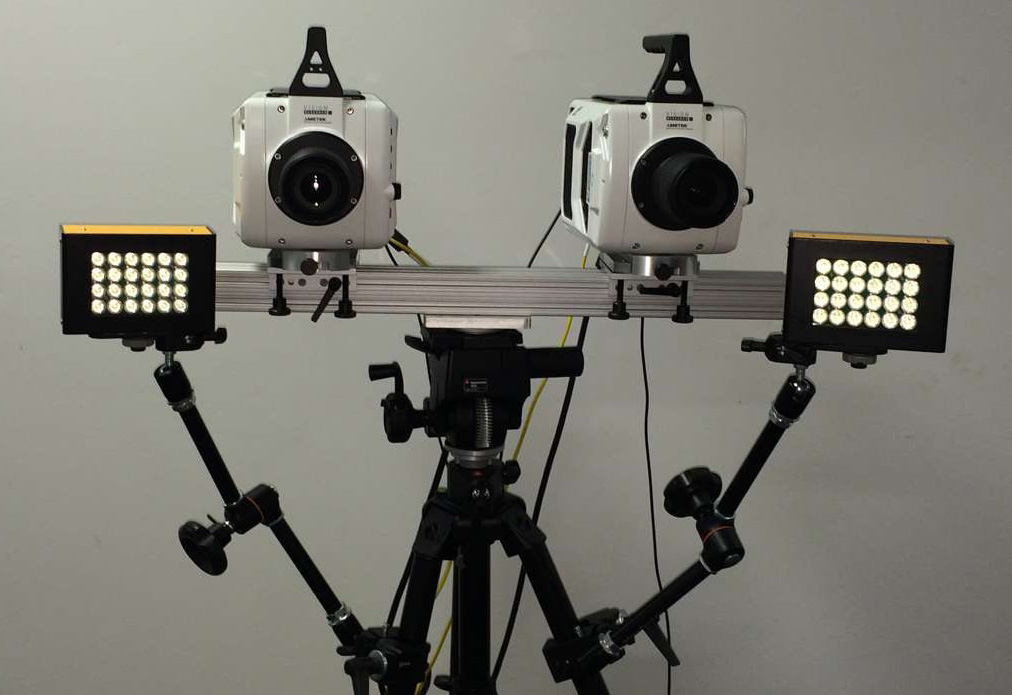
High-speed three-dimensional Digital Image Correlation (3D-DIC): Two Phantom v2511 ultra-high speed cameras (up to 1 Million frames per second) for 3D-DIC measurement (Xing et al. 2017 and Xing et al. 2018)
An integrated high-frequent continuous acquisition and streaming system (i.e., acoustic emission and microseismic) for monitoring natural and human-made hazards.
Awards
2026: Future Fellowship, Australian Research Council (ARC)
2025: Engineering Research Talent Accelerator (ERTA) Fellow, Monash University
2025: John Booker Medal, Australian Academy of Science
2021: Departmental Award for Excellence in Research, Monash University
2020: Discovery Early Career Researcher Award (DECRA), Australian Research Council (ARC)
2019: Dean’s Award for Research Excellence by an Early Career Researcher (ECR), Monash University
2018: Department of Civil Engineering nominee for the Dean’s Award for Excellence in Research by an Early Career Researcher
2018: Future Leader, American Rock Mechanics Association
2018: Reviewers of Excellence Award from Computers and Geotechnics
2016: Rocha Medal Runner Up Certificate, International Society for Rock Mechanics
Membership of Professional Association
Engineers Australia (EA)
Australian Tunnelling Society (ATS)
Australian Geomechanics Society (AGS)
American Rock Mechanics Association (ARMA)
International Society for Rock Mechanics (ISRM)
International Digital Image Correlation Society (iDICs)
International Society of Impact Engineering ( ImpactEng)
International Association of Engineering Geology and the Environment (IAEGE)
Society of Mining Professors (SOMP)
The Australasian Institute of Mining and Metallurgy (AusIMM)
Research Interests
For new PhD applicants:
I have a number of PhD positions. Please check PhD applications steps: https://www.monash.edu/engineering/future-students/graduate-research/how-to-apply.
Applicants are preferred who have an outstanding record which may be evidenced by one or more of the following achievements:
- Top 5% in your department/major from a well-known university, or
- Top 30% in your department/major from a world or region leading university, or
- Awards or prize in major competitions, or
- Strong industrial experience together with near one of the above.
Please send me an email with the following items:
- The email briefly explains your most impressive achievements (e.g., one or more of the above mentioned).
- Attach CV including English test result (IELTS or TOEFL), your GPA and department ranking if possible.
- Attach detailed undergraduate transcript; if you are a postgraduate student, also attach a detailed postgraduate transcript.
Please keep your email short so that your most impressive achievements stand out and I won’t miss them. Due to the limitation on the number of students I can supervise and the high competition, I may only respond to some of the requests. If you are self-funded, please state it in the title of the email.
For new intern/visiting students:
You need to be self-funded and have a strong record like the above described for a PhD student. We have very limited space in the department, so intern/visiting student opportunities are very limited.
Research Projects
Current projects
Dynamic Fracturing and Energy Release Mechanisms in Heterogeneous Materials
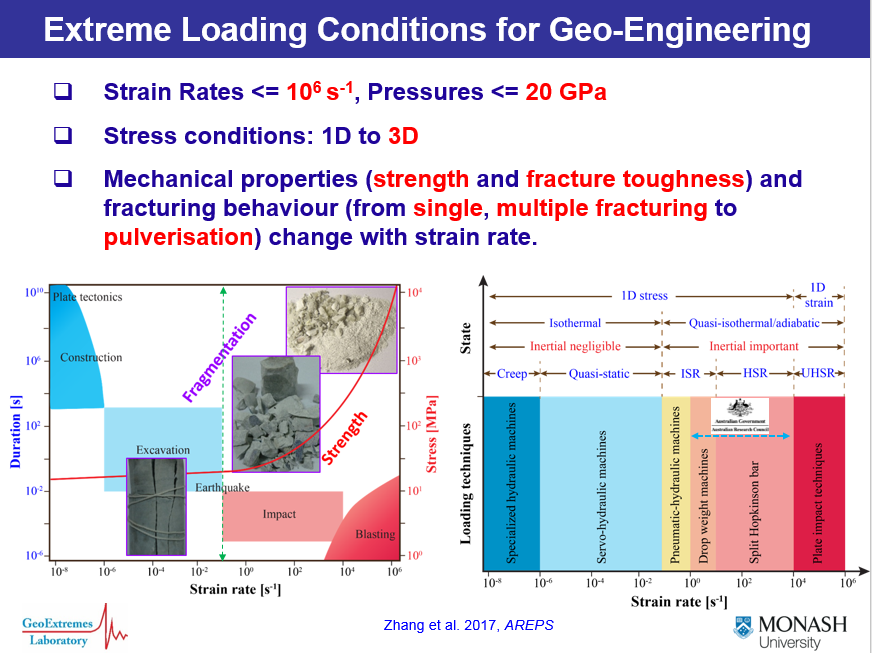
The prediction of fracturing behaviour in geomaterials (i.e. rock, soil and concrete) under dynamic/impact loads is essential in dealing with a wide range of engineering problems including excavation and mining, blasting and fragmentation, earthquake engineering, impact cratering, and protective structure design. However, current knowledge and modelling capabilities of these applications remain empirically based. This project aims to investigate fundamental issues governing the dynamic fracturing of geomaterials and apply this knowledge to advance the understanding and modelling capacity of dynamic fractures in geomaterials.
Nano-science based construction materials for tunnels and underground structures.
This theme aims to reduce the maintenance cost of infrastructure, focusing on road pavements. There are three research directions in this theme,
- The next generation of pavement.
- The next generation of facilities for testing and inspection.
- Strategic appointment to investigate the future underground and
tunneling infrastructure.
Microseismic innovation and technology project
Dynamic fracturing behaviour of geomaterials under multi-axial loadings
Micromechanical analysis of rock burst induced by dynamic loading
This study is to investigate rock and coal burst triggered by dynamic loading from micromechanical perspective. Special attention will be given to analysis of microseismic signals occurring during rock dynamic failure. This work will gain new insights into coal and rock burst mechanism under coupled static and dynamic loading and near in-situ confining stress conditions. The deep understanding of this knowledge will advance monitoring and preventing coal burst hazards in mines with complex geological conditions. The research and funding commitment may be used to target appropriate government funding schemes (e.g., ARC-Linkage and ACARP) to attract further support.
Microwave and laser assisted drilling technologies
Rock dynamic fracturing for geoengineering and mining applications
Past projects
Identification and hazard control due to seismicity induced by EGS production
An experimental investigation on mechanisms of induced seismicity in EGS
- Australian Research Council Grants:
Dynamic Fracturing and Energy Release Mechanisms in Heterogeneous Materials
Nano-science based construction materials for tunnels and underground structures
- Industry Projects:
Microseismic innovation and technology project
Dynamic fracturing behaviour of geomaterials under multi-axial loadings
Micromechanical analysis of rock burst induced by dynamic loading
Microwave and laser assisted drilling technologies
- Monash Internal Grants:
Rock dynamic fracturing for geoengineering and mining applications
Identification and hazard control due to seismicity induced by EGS production
An experimental investigation on mechanisms of induced seismicity in EGS
Supervision
PHD
Mr. Xilin Chen
Suitability for Underground Construction
2022 to 2025
Mr. Feng Xiao
Hydro-mechanical Coupling in Mining and Energy
2021 to 2024
Mr. Yimo Zhu
Risk Assessment of Underground Infrastructure
2021 to 2025
Mr. Pengxuan Ji
Machine Learning and Microseismicity
2021 to 2025
Ms. Huamei Zhu
Digital Twin of Underground Infrastructure
2020 to 2024
Mr. Haojun
Numerical Modelling of Jointed and Veined Rock Mass
2019 to 2024
Mr. Huachuan WANG
Dynamic Mechanical Behaviour of Cement-based Materials under Multi-axial Loadings
2018 to 2022
Mr. Wanrui HU
Dynamic Fracture of Brittle Materials: a Multi-scale Model
2018 to 2022
Ms. Mengqi HUANG
Integrated Numerical Analysis and Building Information Modelling (BIM) for Melbourne Metro Tunnel
2018 to 2022
Mr. Saeed ALIGHOLI
Relationship Between Micro-crack Geometry and Rock Micro-structures
2018 to 2022
Mr. Jing LI
Micromechanical Analysis of Coal Burst Induced by Dynamic Loading
2017 to 2022
Dr. Kai LIU
Dynamic Fracturing Behaviour of Geomaterials under Multi-axial Loadings
2016 to 2020
Dr. Haozhe XING
High Speed 3D Image Correlation Method for Rock Dynamic Fracturing
2015 to 2019
Masters
Mr. Yuhao Zeng
Numerical Modelling of nderground Infrastructure
2020 to 2024
Mr. Xingchen Du
Machine Learning and Image Processing in Lab Tests
2020 to 2022
Mr. Zecheng CHEN
Numerical Modelling of Melbourne State Library Station
2018 to 2020
Teaching Commitments
- MNE3010 - Rock Mechanics (2015-2017), Coordinator
- MNE3040 - Surface Mining Systems (2015), Coordinator
- RSE4112 - Advanced Rock Mechanics (2018), Coordinator
- CIV5885 - Infrastructure Dynamics (2018- )
- CIV5886 - Infrastructure Geomechanics (2018- ), Coordinator
- RSE3010 - Mine Geotechnical Engineering (2019- ), Coordinator
- RSE3241 - Hydropower (2023- ), Coordinator